
People

People
Professor
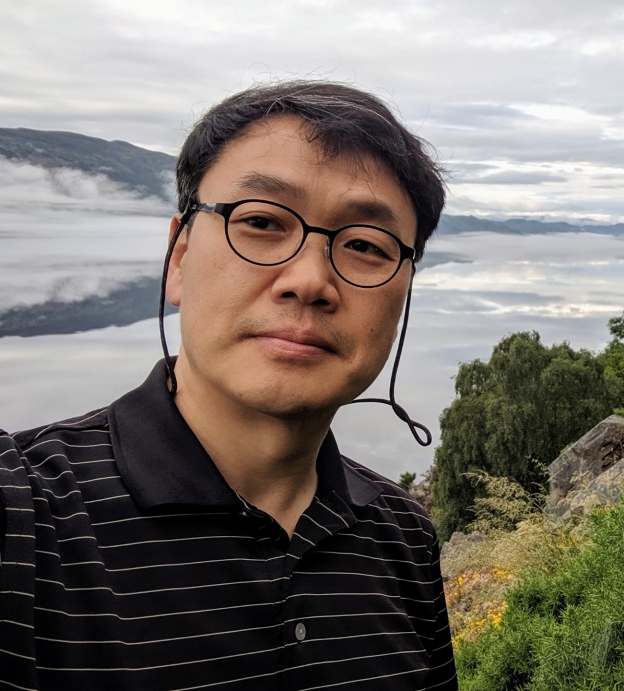
Cheol-Min Ghim김철민
- 위치108동 401-7호
- 메일cmghim@unist.ac.kr
- 전화052-217-2517
연구주제
Theoretical Biophysics; Complex Systems
- 연구분야복잡계 ; 네트워크생물학 ; 비평형통계물리
- 연구실Ghim Lab
Current Research Interests
- The Ghim Lab seeks to uncover the “design principles” underlying complex networks of biological information processing. Our research spans cellular metabolism, gene regulation, cell–cell communication, and social and ecological interactions among organisms. Current research focuses on:
- • [Physics of living systems] Nonequilibrium principles underlying biological organization
- • [Biological control] Pontryagin’s maximum principle in biological systems
- • [Cellular economy] Resource allocation and coordination in cellular metabolism
- • [Microbial ecosystems] Host–microbiome interactions and community dynamics
- From a biological perspective, we aim to understand the robustness of biological networks through the duality between form and function. The complementary goal is to bring the precision and reliability of biochemical control—in areas such as synthetic biology and metabolic engineering—closer to that achieved in silicon-based systems.
- Both objectives are closely connected to fundamental questions in the equilibrium and nonequilibrium statistical mechanics of complex systems. Information theory and statistical mechanics provide our principal conceptual and analytical tools, but rigorous biological realism remains at the heart of our work.
Biographical Sketch
- Cheol-Min Ghim is a statistical physicist guided by the principle that “more is different”: when vast numbers of simple components interact, qualitatively new phenomena emerge that cannot be understood from the components alone. A crowd is more than a collection of individuals, a magnet more than an assembly of atoms, and a living cell more than a mixture of molecules. His research draws on physics, probability, thermodynamics, and complex-network theory to uncover the principles behind such emergent behavior—from gene regulation within a single cell to the collective dynamics of social systems. As an educator in the age of AI, he is increasingly concerned with how the next generation can learn, create, and flourish alongside machine intelligence. This commitment has led him to serve as Head of the School of GRIT Convergence Studies at UNIST.
- • B.S. in Physics (1994), Seoul National University
- • Ph.D. in Physics (2003), Seoul National University
- • Postdoctoral researcher at Center for Theoretical Physics, SNU (2003-04), Seoul National University; Center for Theoretical Biological Physics, UC San Diego (2004-06); Lawrence Livermore National Laboratory (2006-09);
- • Visiting Professor, Mathematical Biosciences Institute, Ohio State University (2015-16)
- • Professor in School of School of Nano-Bioscience & Chemical Engineering, School of Life Sciences, Department of Biomedical Engineering, and Department of Physics, UNIST (2009-)
Selected Publications
- • S. Bahng, J. S. Lee, and C.-M. Ghim, Memory-aware feedback enhances power in active information engines, Phys. Rev. E 112, 054134 (2025).
- • V. A. Baulin, C.-M. Ghim et al., Intelligent Soft Matter: Towards Embodied Intelligence, Soft Matt. 21, 1888 (2025).
- • J. Chae, R. Lim, T. L. P. Martin, C.-M. Ghim, P.-J. Kim, Enlightening the blind spot of the Michaelis–Menten rate law: The role of relaxation dynamics in molecular complex formation, J. Theo. Biol. 597 (12) 111989 (2024).
- • R. Lim, T. L. P. Martin, J. Chae, W. Kim, H. Kim, C.-M. Ghim, P.-J. Kim, Generalized Michaelis-Menten rate law with time-varying molecular concentrations, PLoS Comput. Biol. 19 (12): e1011711 (2023).
- • J. Chae, R. Lim, C.-M. Ghim, P.-J. Kim, Backward simulation for inferring hidden biomolecular kinetic profiles, STAR Protocol 2, 100958 (2021).
- • R. Lim, J. Chae, David E. Somers, C.-M. Ghim, P.-J. Kim, Cost-effective circadian mechanism: rhythmic degradation of circadian proteins spontaneously emerges without rhythmic post-translational regulation, iScience 24, 102726 (2021).
- • M. K. Sung, J. Jang, K. S. Lee, C.-M. Ghim, J. K. Choi, Selected heterozygosity at cis-regulatory sequences increases the expression homogeneity of a cell population in humans, Genome Biol. 17, 164 (2016).
- • C.-M. Ghim, E. Almaas, Two-component genetic switch as a synthetic module with tunable stability, Phys. Rev. Lett. 103, 028101 (2009).
- • C.-M. Ghim et al., Kinetic roughening of ion-sputtered Pd(001) surface: Beyond the Kuramoto-Sivashinsky model, Phys. Rev. Lett. 92, 246104 (2004).
- • K.-I. Goh, C.-M. Ghim, B. Kahng, D. Kim, Reply to the comment on universal behavior of the load distribution, Phys. Rev. Lett. 91, 189804 (2003).